
Skill
insurance-claims-fraud
detect insurance claims fraud using graph analysis
Description
Detect insurance claims fraud by modelling claimants, medical professionals, vehicles, and claims as a graph. Provides a graph model, bundled sample data, and Cypher for repeat claimants, unusual medical-professional activity, and vehicles reused across claims.
SKILL.md
Insurance Claims Fraud
Use this skill for insurance fraud analysts and developers investigating claims fraud (staged accidents, exaggerated injuries, inflated costs, crash-for-cash rings) by exploring the relationships between claimants, medical professionals, vehicles, and claims.
Source reference:
Disclaimer: this is an illustrative, synthetic model for demonstration. Real claims fraud detection needs validated data, thresholds tuned to the portfolio, and human review before any decision. Do not present model choices, thresholds, or query behaviour as proven guidance.
Introducing this package
When the user first opens this package, greet them with a short introduction in your own words — don't recite this file. Convey:
- The core idea: fraudulent claims (staged accidents, exaggerated injuries, inflated repair costs) tend to hide in the relationships between parties rather than in any single record — the same vehicle across several claims, one doctor tied to an unusual share of high-value claims, a claimant filing repeatedly.
- The bundled sample data is synthetic and deliberately seeds each of those patterns, so the
queries in
QUERIES.mdreturn results straight away. - A schema diagram is available to show when explaining the model: https://neo4j.com/developer/industry-use-cases/_images/insurance/insurance-claims-fraud-schema.svg
- What you can help with: explaining the model, walking through the query patterns (repeat claimants, unusual medical-professional activity, reused vehicles), importing the sample data or their own, and running Cypher once a database is connected.
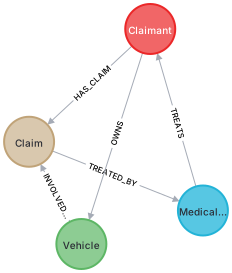
End with a clear next step, such as asking whether they'd like to explore the model or start importing data.
Model
- Nodes:
Claimant {name},MedicalProfessional {name},Claim {claimID, date, amountClaimed},Vehicle {VIN}. - Relationships:
(Claimant)-[:HAS_CLAIM]->(Claim),(Claim)-[:TREATED_BY]->(MedicalProfessional),(Claimant)-[:OWNS]->(Vehicle),(Vehicle)-[:INVOLVED_IN]->(Claim),(MedicalProfessional)-[:TREATS]->(Claimant). - Full schema, mappings, and sample CSVs are in
GRAPH_MODEL.jsonandsample-data/; runnable Cypher with expected results is inQUERIES.md.
Operational Constraints
- Prefer the bundled
sample-data/Import flow. No post-import setup is required — do not improvise indexes or constraints after Import. - The Graph Data Science queries in
QUERIES.mdrequire the GDS library and are unproven; flag that before running. - Thresholds in the queries (claim count, total amount) are illustrative parameters; tune per portfolio.
Response Shape
When returning guidance, keep output structured:
Model assumptions
Cypher (if requested)
What this detects
Tuning options
Validation approach
More skills from the studio-agent-use-cases repository
View all 5 skillsev-route-planning
plan electric vehicle routes with graph analysis
Aug 18Graph AnalysisLogisticsNeo4jOptimizationidentity-validation
resolve identities across systems using graph analysis
Aug 18Data EngineeringGraph AnalysisIdentityNeo4jpatient-journey
analyze patient journeys using graph models
Aug 18Data AnalysisGraph AnalysisHealthcareNeo4jretail-banking
detect retail banking fraud rings
Aug 18FinanceGraph AnalysisNeo4jSecurity